









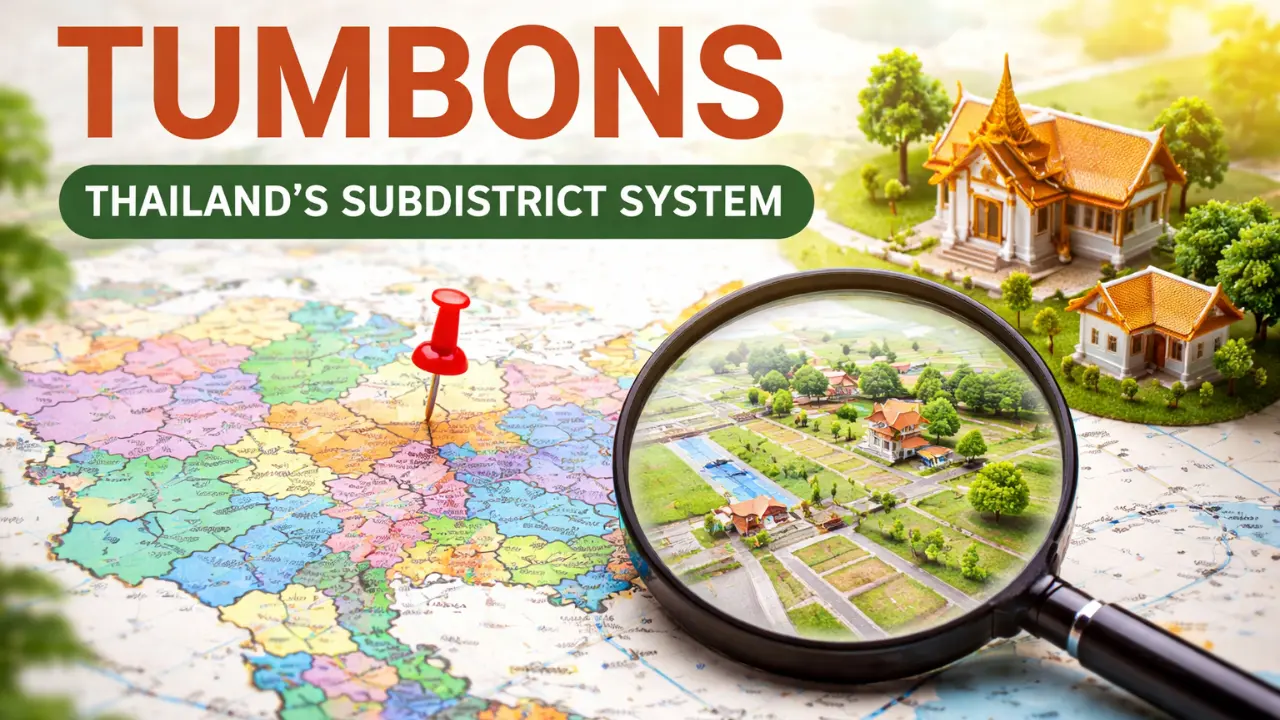
If you’ve ever looked at a Thai address, planned a trip beyond major cities, or tried to understand how local communities are organized, you’ve probably run into the word tumbons. It’s one of those everyday terms in Thailand that quietly does a lot of work—helping define where people live, how services are delivered, and how communities manage local needs.
This article breaks the topic down in a simple, practical way so you can understand what it means, where it sits in the system, and why it matters.
What tumbons are and what the word means
A “tambon” is commonly translated as a subdistrict in Thailand. Think of it as a local area that sits between a district and a village. It’s not just a label on a map; it’s a unit used in administration, addressing, and local planning.
People often spell it differently in English. You may see “tambon,” “tumbon,” or the plural form used online. In most official and widely accepted usage, “tambon” is standard, but the meaning stays the same: a defined subdistrict area within a larger district.
Where tumbons fit in Thailand’s administrative structure
Thailand’s administrative system is layered so that responsibilities can be handled at different levels. A straightforward way to understand it is from larger to smaller:
- Province
- District
- Subdistrict
- Village
The subdistrict level is where many everyday community details start to make sense. Each subdistrict contains multiple villages, and those villages are where most local life happens—homes, farms, markets, schools, and community spaces.
This structure also helps with public services. When a government office plans road repairs, water access, local health programs, or community funding, the subdistrict level helps define the target area clearly.
How a subdistrict is different from a district or a village
It’s easy to mix these up, especially if you’re new to Thai geography.
A district is larger and usually includes many subdistricts. It’s the level where you might find bigger government offices, a main police station, or major administrative services.
A village is smaller and more personal. Villages are where people identify with local communities, traditions, and neighborhood leadership.
The subdistrict sits in between. It groups villages together into a practical unit for managing shared needs. Roads don’t stop at village borders, drainage systems serve several villages, and local development plans are often designed for a whole subdistrict rather than a single small settlement.
What local administration looks like at subdistrict level
Local administration is one of the main reasons the subdistrict level exists. Many subdistricts have local organizations responsible for services that impact day-to-day life, such as:
- Maintenance of local roads and small bridges
- Waste collection and basic sanitation
- Local parks, community spaces, and public lighting
- Community development projects
- Support for local events and culture
Some areas have more urban characteristics and may fall under a different type of local municipality. Rural and semi-rural areas often rely heavily on subdistrict-level administration to keep services running and respond to local needs.
This is also where local priorities become visible. Two subdistricts within the same district can feel completely different depending on geography, budget, population, and leadership.
Why tumbons matter for travel, addresses, and navigation
For travelers, expats, and anyone doing business locally, understanding this subdistrict layer can be surprisingly useful.
When you book accommodation outside major cities, arrange deliveries, or look up a location on Thai websites, the subdistrict often appears as part of the address. It helps narrow down places with similar village names and reduces confusion when multiple communities share common words.
In rural provinces, the subdistrict name is often used to describe an area’s identity. It may also appear in public transport information, local markets, hospitals, and government services.
If you’re planning to explore less touristy areas, knowing the subdistrict can help you search more accurately, communicate with drivers, and confirm you’re heading to the right place.
How to find the right tumbons when searching locations
If you’re trying to identify a specific place, this approach usually works well:
- Start with the province and district name.
- Add the subdistrict name from an address, local listing, or map.
- Cross-check nearby landmarks or village names.
This is especially helpful when a location name is common. Adding the subdistrict often improves search accuracy because it narrows results to a smaller geographic area.
It’s also a practical tool for people researching property, local schools, community facilities, or regional development, because many datasets and official records are organized at the subdistrict level.
Common misunderstandings and quick clarity
One common misunderstanding is assuming subdistricts are the same everywhere in the country in terms of size and population. In reality, the size and density of a subdistrict can vary widely. Some are compact and highly populated, while others cover wide rural areas with scattered villages.
Another misunderstanding is thinking the subdistrict is only a bureaucratic label. In many places, it influences local identity, budgeting, development planning, and the way services are delivered. It’s the practical “middle layer” that connects district-level administration with real village-level life.
Conclusion
Understanding subdistricts gives you a clearer picture of how Thailand is organized beyond the big headlines of provinces and cities. It helps you read addresses properly, search locations more accurately, and understand how local services and development work in everyday communities. Whether you’re researching, traveling, relocating, or simply curious about how places are structured, the subdistrict layer is one of the most practical building blocks to know.
Five quick FAQs
What are tumbons in simple words?
They are subdistrict areas in Thailand that sit below districts and above villages, used for administration and addressing.
Are tumbons the same as districts?
No. Districts are larger and contain multiple subdistricts, while subdistricts group together multiple villages.
Why do Thai addresses include subdistrict names?
Because subdistrict names help pinpoint locations more accurately, especially when place names are common across regions.
Do subdistricts have local government offices?
Many do, through local administrative organizations or municipal structures that handle community services and development.
How can I confirm which tumbons a place belongs to?
Check the full address format (province, district, subdistrict), then confirm with maps or local listings that show administrative boundaries.